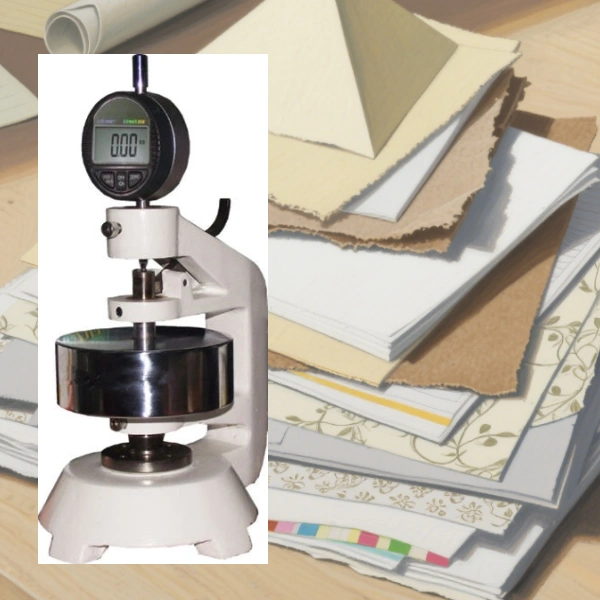
instrument used to measure thickness of paper
Paper Thickness Tester
A paper thickness tester measures paper thickness accurately for consistent quality.
About Us
Paper Thickness Tester
A paper thickness tester is a precision instrument designed for the measurement of thickness of paper in millimeters. Also known as a paper thickness gauge or micrometer paper, it provides reliable and repeatable results. Modern models include digital coating thickness gauge and electronic thickness gauge systems, offering high accuracy for both laboratory and industrial use. The instrument is widely used as a paper thickness measurement tool to ensure consistent product quality.
Technical Parameters
01
Principle
Paper thickness measurement is based on applying a controlled pressure to the sample and measuring the distance between two contact surfaces. The thickness is determined by the gap at which the paper just fits, ensuring accurate and repeatable readings.
02
Precautions
- Ensure the instrument is calibrated before use.
- Handle paper samples carefully to avoid wrinkles or folds.
- Avoid applying excessive pressure that may compress the paper unevenly.
- Keep the measuring surfaces clean and free of dust.
- Conduct measurements at a consistent temperature and humidity to ensure accuracy.
03
Main Parameters
| Test Range | (0 ~ 4)mm |
| Resolution | 0.001mm |
| Contact Area | (200±5)mm² |
| Contact Pressure | 100±10kPa |
| Measuring Surface parallelism | ≤0.005mm |
| Display Error | ±0.05% |
Paper Thickness Measurement Tool
Standards Reference
The testing of paper thickness is regulated by international standards, with ISO 534 being the most recognized reference. ISO 534 specifies the procedure for the measurement of thickness of paper and board, ensuring results are consistent across industries. Compliance with ISO standards guarantees that a paper thickness measuring instrument delivers precise data that meets global quality expectations.
thickness of paper measurement
Importance of Paper Thickness Tester
Measuring paper thickness is a critical step in ensuring product quality, performance, and reliability. The thickness of paper or board directly influences its mechanical properties, printability, and suitability for specific applications. Accurate measurement is essential for the following reasons:
Printing Quality
Paper that is too thin or uneven can lead to ink absorption problems, smudging, or misalignment during printing, resulting in poor print quality and increased production defects.
Packaging Strength
In packaging applications, especially for cartons and paperboard, incorrect thickness can compromise structural integrity, causing boxes to collapse, tear, or fail during transport and storage.
Quality Compliance
Many international standards and customer requirements specify thickness tolerances. Deviations can result in product rejections during quality audits, affecting brand reputation and increasing costs.
Waste Reduction and Cost Efficiency
Reliable thickness measurement helps manufacturers reduce material waste, avoid overuse of paper, and optimize production processes, improving overall efficiency and cost-effectiveness.
Instrument Used to Measure The Thickness of a Paper
Paper Thickness Tester of Application
Paper and Packaging
Controls material thickness to guarantee strength, durability, and reliable packaging while reducing waste.
Printing Industry
Ensures uniform thickness for better print quality, ink absorption, and machine compatibility, preventing misalignment or paper jams.
Textile and Coating
Verifies uniformity of coated or laminated papers, enhancing appearance and functional performance, especially when combined with a digital coating thickness gauge.
Quality Control Laboratories
Confirms products meet standards and specifications before release, ensuring quality compliance and customer satisfaction.
Our Advantages
01
Our paper thickness tester offers:
- High Accuracy & Stability: Advanced sensors ensure precise, consistent measurements.
- User-Friendly Design: Digital interface for easy operation.
- Standard Compliance: Meets ISO 534 requirements.
- Versatility: Suitable for paper, board, and coated materials.
- Customization: Tailored solutions for specific production needs.
Reliable, efficient, and ideal for quality control across industries.

The paper thickness tester measures paper in millimeters, providing accurate, repeatable readings. Digital models suit both lab and industrial use, ensuring consistent quality.
– CELL INSTRUMENTS
Frequently Asked Questions
Q1: What is the standard unit for paper thickness measurement?
A1: Paper thickness is typically measured in millimeters or microns, in line with ISO 534.
Q2: Which instrument is used to measure the thickness of paper?
A2: A paper thickness tester, also known as a micrometer paper or electronic thickness gauge, is commonly used.
Q3: Why is thickness testing important in packaging?
A3: Packaging paper with inconsistent thickness may lead to deformation, reduced protection, or product damage.
Q4: Is a digital paper thickness gauge better than a manual one?
A4: Yes. A digital coating thickness gauge offers higher accuracy, faster reading, and easier data recording.
Q5: Does your tester meet international standards?
A5: Yes, our paper thickness measuring instrument is fully compliant with ISO 534 and related testing protocols.


Get in touch
No. 5577 Gongyebei Rd, Licheng, Jinan, 250109, Shandong, P.R.C.
marketing@celtec.cn
+86 185 6001 3985
 EN
EN  AR
AR  BG
BG  CS
CS  DA
DA  DE
DE  EL
EL  ES
ES  ET
ET  FI
FI  FR
FR  HU
HU  ID
ID  IT
IT  JA
JA  KO
KO  LT
LT  LV
LV  NB
NB  NL
NL  PL
PL  PT
PT  RO
RO  RU
RU  SK
SK  SL
SL  SV
SV  TR
TR  UK
UK